Asset Class Quilt of 2025
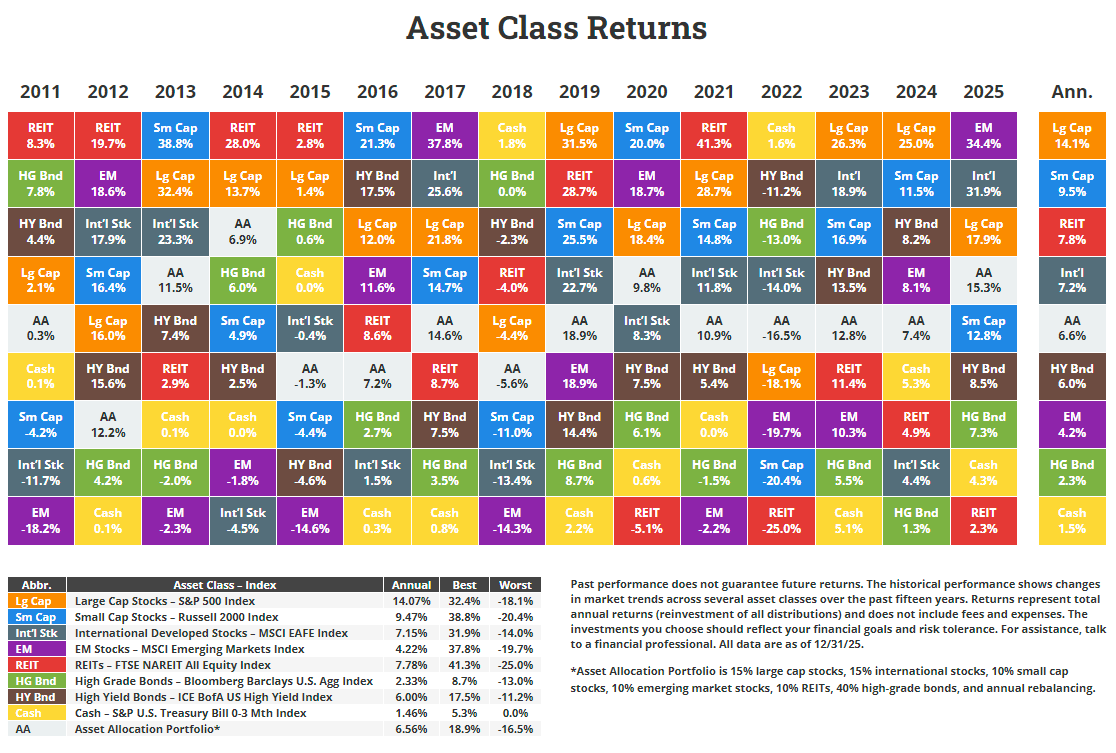
If you have ever seen an “asset class quilt” chart, you know it can look chaotic at first glance. Each column represents a year. Each colored box shows how a different asset class performed, ranked from best to worst. When you step back, however, the pattern tells a powerful story about leadership, diversification, and how investors experience risk.
The 2011 through 2025 asset class quilt is not just a history lesson. It is a visual reminder that markets rotate, winners change, and outcomes are rarely predictable year to year.
 Source: NovelInvestor.com
Disclaimer: This is not a recommendation for investments. This is for information purposes only. Please consult with your tax professional or financial professional before making changes to your personal accounts.
Key Takeaways
Asset class leadership rotates constantly.
No single asset class stays at the top for long.
Diversified portfolios rarely lead, but they also rarely collapse.
Risk is about variability, not just return.
The range of outcomes matters as much as the average.
The Shifting Winners and Losers
One of the clearest lessons from the quilt is that leadership rotates.
In some years, REITs, small caps, or emerging markets sit at the top of the column. A few years later, those same asset classes appear in the middle or near the bottom. International and emerging market stocks, in particular, show a boom and bust pattern. They can post very strong gains, including results above 30 percent in certain years, and then follow with significant declines.
U.S. large cap stocks have been strong long term contributors, as reflected in the annualized return column on the far right. Yet even large caps have experienced periods where they lagged small caps, international stocks, or real estate.
Bonds and cash tend to live in the middle or bottom of the ranking. High grade and high yield bonds rarely top the chart. Still, their long term annualized returns are positive and their year to year movements are narrower than most equity categories.
The broader pattern is clear. Every asset class takes a turn leading and lagging. The chart visually undermines the idea that last year’s winner is likely to repeat.
What the Diversified Row Quietly Reveals
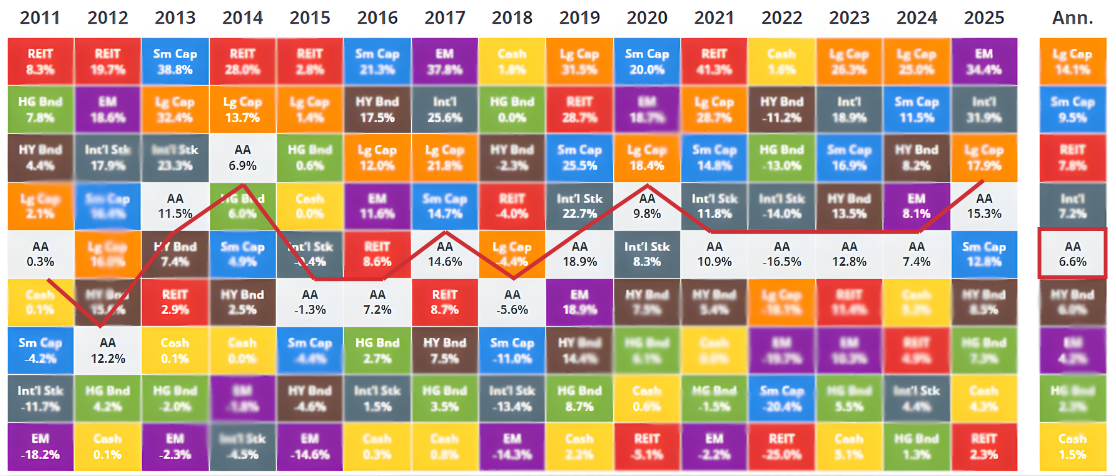
The “Asset Allocation Portfolio” row may not stand out at first glance. It rarely finishes first. It rarely finishes last.
Instead, it tends to cluster in the middle of the rankings almost every year.
Over the full period, its annualized return is competitive with many individual asset classes, yet its year to year swings are noticeably narrower than the more volatile equity segments. The visual contrast is subtle but consistent. Extreme colors appear less frequently in this row.
Rather than chasing leadership, the diversified row reflects blended exposure. It captures pieces of different winning years without being fully exposed to any single losing one. The outcome is steadier participation across cycles.
Rethinking Risk When You Look at Returns
The most striking feature of the quilt is the vertical dispersion. Some asset classes leap from top to bottom within a short span of years. That visual volatility is risk in motion.
Emerging markets and REITs show wide swings. Bonds and cash move within a tighter band. The difference is not just return level, but return variability.
The diversified allocation compresses that dispersion. Its path across the chart is smoother, with fewer dramatic jumps. This reframes risk as the range of possible annual outcomes rather than simply the long term average.
Seeing one asset class at the bottom in a given year is headline risk. The portfolio’s combined result is portfolio risk. The quilt shows how different those two experiences can be.
Final Thoughts
The asset class quilt is a visual history of unpredictability. Leadership rotates. Volatility differs widely across asset classes. Blended exposure produces a different experience than concentration.
Markets will continue to shift. The quilt simply reminds us that unpredictability is not an anomaly. It is the structure of investing itself.