Chart of the Month: January
If you felt that the 2025 news cycle felt relentless, you were not imagining it.
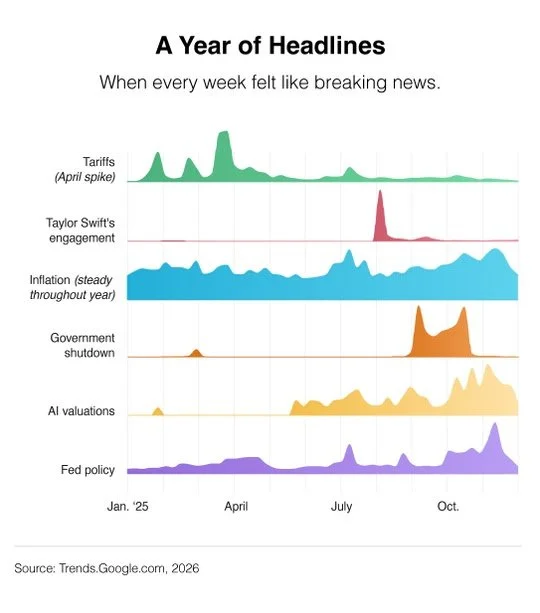
This month’s chart tracks what captured America’s attention throughout the year and how quickly one major story replaced another. The data reflects collective search behavior, giving us a window into what felt urgent at different moments in time.
Key Takeaways
Headlines rotate faster than most investment strategies should.
Market reactions often align with news events, but not always for long.
Stories that feel dominant today often fade within weeks.
Disciplined strategies are designed to outlast news cycles.
What Captured Attention in 2025
Each spike on the chart represents a moment when the country collectively searched for answers.
In April, tariff policy dominated search activity. Inflation concerns resurfaced repeatedly throughout the year. There were fears of a government shutdown. Even cultural moments, such as Taylor Swift’s engagement, generated measurable spikes in attention.
What stands out is not just the volume of news. It is the speed at which one story gave way to the next.
Something that felt urgent in April often barely registered by mid-summer.
The Market Connection
There were several moments in 2025 when headlines and market movement appeared closely connected.
When tariff announcements took center stage in April, the S&P 500 declined nearly 20 percent. Within days, sentiment shifted, and the market posted its strongest single day since 2008, rising more than 9 percent. By June, the index had reached a new all-time high.
Inflation remained a recurring headline throughout the year. While search activity reflected persistent concern, markets showed resilience as the Federal Reserve responded to economic data rather than headlines.
The relationship between news and markets is real. It is also often temporary.
Why Headlines Move Markets
Markets respond to uncertainty.
When trade policy shifts, investors reassess supply chains, earnings expectations, and corporate margins. When Federal Reserve officials speak, interest rate expectations adjust. These reactions are logical.
What history shows, however, is that the adjustment process tends to happen quickly.
Tariff fears, government shutdown concerns, AI valuation debates, and shifts in Fed policy all created sharp spikes in attention. Markets absorbed the information, recalibrated, and continued forward.
The urgency of the moment often fades faster than long-term capital markets trends.
Staying the Course
If 2025 reinforced anything, it is this: news cycles are relentless, markets are resilient, and strategies should be built with a longer time horizon in mind.
The stories that dominated Google searches in January were barely discussed by year-end.
That pattern is unlikely to change in 2026. New headlines will emerge. Attention will spike. Markets will react and adjust.
What matters most is that your investment strategy remains aligned with your long-term objectives rather than the trending topic of a given week.
This material was developed and produced by FMG Suite to provide information on a topic that may be of interest. FMG Suite is not affiliated with Bethesda Wealth Planning Group.