Weekly: AI and Inflation Concerns Pressure Markets

Stocks declined last week as investors weighed growing concerns about artificial intelligence disruption alongside a warmer-than-expected wholesale inflation report. While tech stocks briefly rebounded midweek, inflation data and renewed uncertainty pressured markets into the close.
Key Takeaways
AI disruption concerns broadened beyond tech and weighed on sentiment
A midweek relief rally faded as inflation pressures resurfaced
Wholesale inflation came in hotter than expected
International stocks outperformed U.S. markets
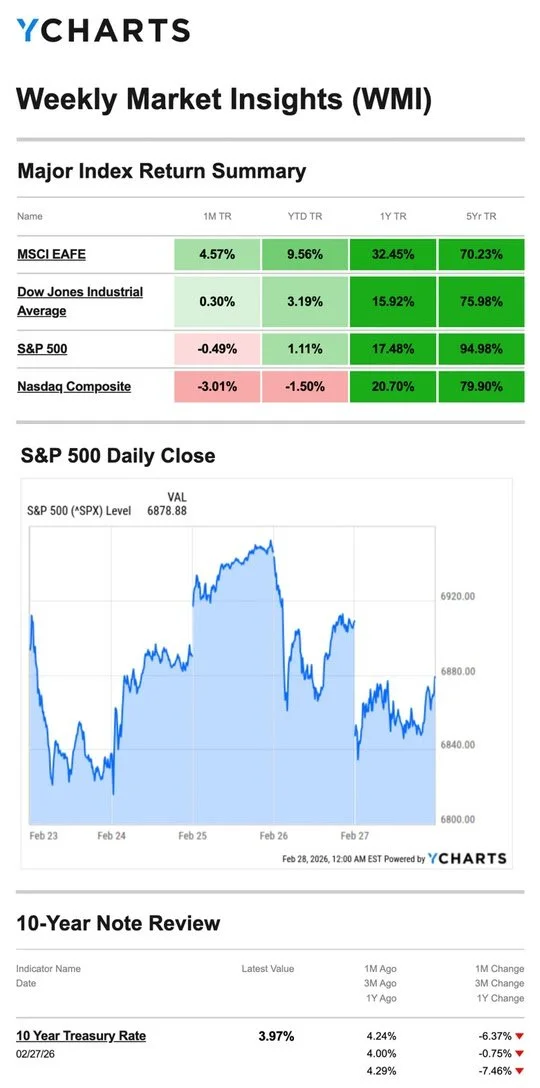
YCharts.com, February 28, 2026. Weekly performance is measured from Monday, February 23, to Friday, February 27.
Market Performance Snapshot
The S&P 500 Index declined 0.44 percent for the week, while the Nasdaq Composite fell 0.95 percent, reflecting pressure in growth-oriented sectors. The Dow Jones Industrial Average dropped 1.27 percent, underperforming both the S&P 500 and Nasdaq despite still leading year to date.
In contrast, developed international stocks gained 1.22 percent. The divergence highlighted continued dispersion beneath the surface, with global equities showing relative resilience even as U.S. indexes faced inflation and sector-specific headwinds.
AI Disruption Fears Spread
Markets opened under pressure as a widely circulated research report suggested artificial intelligence could influence a broader set of industries and potentially affect the unemployment rate. That narrative extended beyond traditional technology companies and contributed to early-week volatility.
Stocks rebounded over the next two sessions as investors stepped into what appeared to be an oversold AI trade. Software, cybersecurity, and semiconductor-related names participated in the relief rally, helped by optimism surrounding a prominent chipmaker’s upcoming earnings report.
However, the rally lost momentum late in the week. The Dow Industrials weakened noticeably over the final two sessions, underperforming on Friday and for the week, even though it remains ahead of other major averages year to date.

Wholesale Inflation Reignites Rate Concerns
Friday’s shutdown-delayed Producer Price Index report showed wholesale inflation rose 0.5 percent in January, above the 0.3 percent economists had expected.
Because PPI measures input costs for businesses, stronger readings often raise concerns that higher costs could eventually be passed along to consumers. Inflation data that remains above the Federal Reserve’s 2 percent target can complicate expectations around future rate policy.
The hotter reading added pressure to equities into the weekend, reinforcing the view that inflation remains a central market driver.
This Week: Key Economic Data
Monday
PMI—Manufacturing
ISM Manufacturing
Auto Sales
Tuesday
Fed Presidents John Williams (New York) and Neel Kashkari (Minneapolis) speak
Wednesday
ADP Employment Report
PMI—Services
ISM Services
Federal Reserve Beige Book
Thursday
Weekly Jobless Claims
Q4 Productivity
Import Prices
Friday
Federal Employment Report
Cleveland Fed President Beth Hammack speaks
This Week: Companies Reporting Earnings
Tuesday
CrowdStrike (CRWD)
Wednesday
Broadcom Inc. (AVGO)
Thursday
Costco Wholesale Corporation (COST)
Marvell Technology, Inc. (MRVL)

All about but unseen, can be captured but can’t be held, has no throat but can be heard. What is it?
Last Week's Riddle: Brothers and sisters, I have none, but this man's father is my father's son. Who am I talking about?
Answer: My son.
Footnotes And Sources
1. WSJ.com, February 27, 2026
2. Investing.com, February 27, 2026
3. CNBC.com, February 23, 2026
4. CNBC.com, February 25, 2026
5. WSJ.com, February 27, 2026
6. IRS.gov, August 18, 2025
7. Zacks, February 27, 2026.
8. Investors Business Daily - Econoday economic calendar; February 27, 2026.
This material was developed and produced by FMG Suite to provide information on a topic that may be of interest. FMG Suite is not affiliated with Bethesda Wealth Planning Group.