New 2026 Tax Changes You Should Know
Tax rules are shifting again. Several updates will apply when you file your 2025 return, and even more adjustments arrive in 2026. Between inflation adjustments, contribution limit increases, and new deduction rules, this is a good time to review how these changes may impact your income, retirement planning, and charitable giving.
Below is a simple breakdown of what is changing.
Disclaimer: This is for information purposes only and should not be considered individual tax advice. Consult with your financial professional or tax professional before making any changes.
2026 Income Tax Brackets
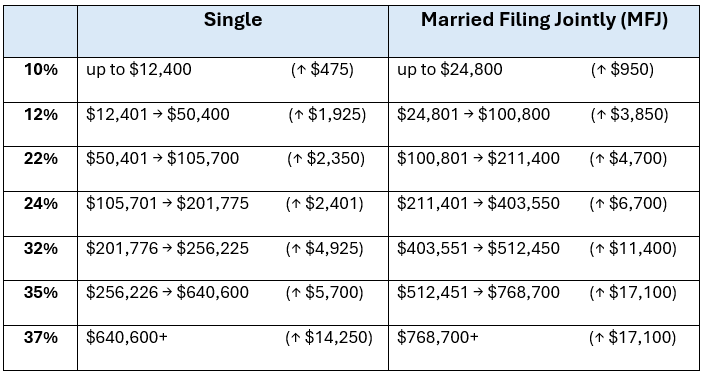
The IRS released inflation-adjusted tax brackets for income earned in 2026. These apply when filing your 2026 return in early 2027.
Standard Deduction Increases in 2026
The 2026 standard deduction is projected to rise due to the One Big Beautiful Bill Act and annual inflation indexing.
Expected amounts:
• Single: about $16,100
• Married Filing Jointly: about $32,200
• Head of Household: about $24,150
This continues the trend of higher deductions and fewer households needing to itemize.
Annual Gift Exclusion in 2026
The annual gift exclusion remains $19,000 per recipient.
This allows individuals to transfer wealth efficiently without using lifetime exemption amounts.
For Example: spouses can gift $19,000 x 2 per recipient.
SALT Deduction Increase in 2025 and Beyond
Beginning in 2025, the state and local tax (SALT) deduction cap rises:
• New cap: $40,000
• Married filing separately: $20,000 per person
• Phase down begins for incomes above $500,000
This is a meaningful change for households in high-tax states such as Maryland, Virginia, and the District of Columbia.
2026 Retirement Plan Contribution Limits
Retirement savers will see higher limits across many plan types.
401(k) Elective Deferrals
• Under age 50: $24,500
• Catch-up provision: Age 50 to 59: $32,500 (+$8,000)
• Super Catch-up provision: Age 60 to 63: $35,750 ($8,000 + $3,250)
• Age 64 and older: $32,500
Defined Contribution Maximum Annual Additions
• Under age 50: $72,000
• Age 50 to 59: $80,000
• Age 60 to 63: $83,250
• Age 64 and older: $80,000
Annual Compensation Limit: $360,000
Highly Compensated Employee Threshold: $160,000 in 2025 compensation
These higher thresholds create greater planning opportunities for business owners and employees with access to employer plans.
IRA Contribution Limits in 2026
IRA contribution limits increase again:
• New annual limit: $7,500
• Catch-up contribution (age 50+): $1,100
The SECURE 2.0 Act added inflation indexing to the catch up amount, which is why it now adjusts annually.
New Charitable Giving Rules in 2026
Charitable giving rules shift in two meaningful ways:
• A new above-the-line charitable deduction for non-itemizers of about $1,000 for single filers and $2,000 for married filing jointly.
• Itemizers face a 0.5% of AGI floor for charitable deductions.
• High earners face a 35% cap on the marginal tax benefit of charitable gifts.
These rules change the balance between Qualified Charitable Distributions, Donor Advised Funds, and cash gifts. Households who give consistently may want to revisit their strategy to determine the most efficient approach in 2026.
Final Thoughts
Several tax adjustments are now locked in for 2025 and 2026. These include higher deductions, higher contribution limits, and updated bracket thresholds. More importantly, charitable giving and SALT deductions shift in ways that may reshape year end planning. Reviewing your tax plan early can help you take advantage of these updates before they take effect.